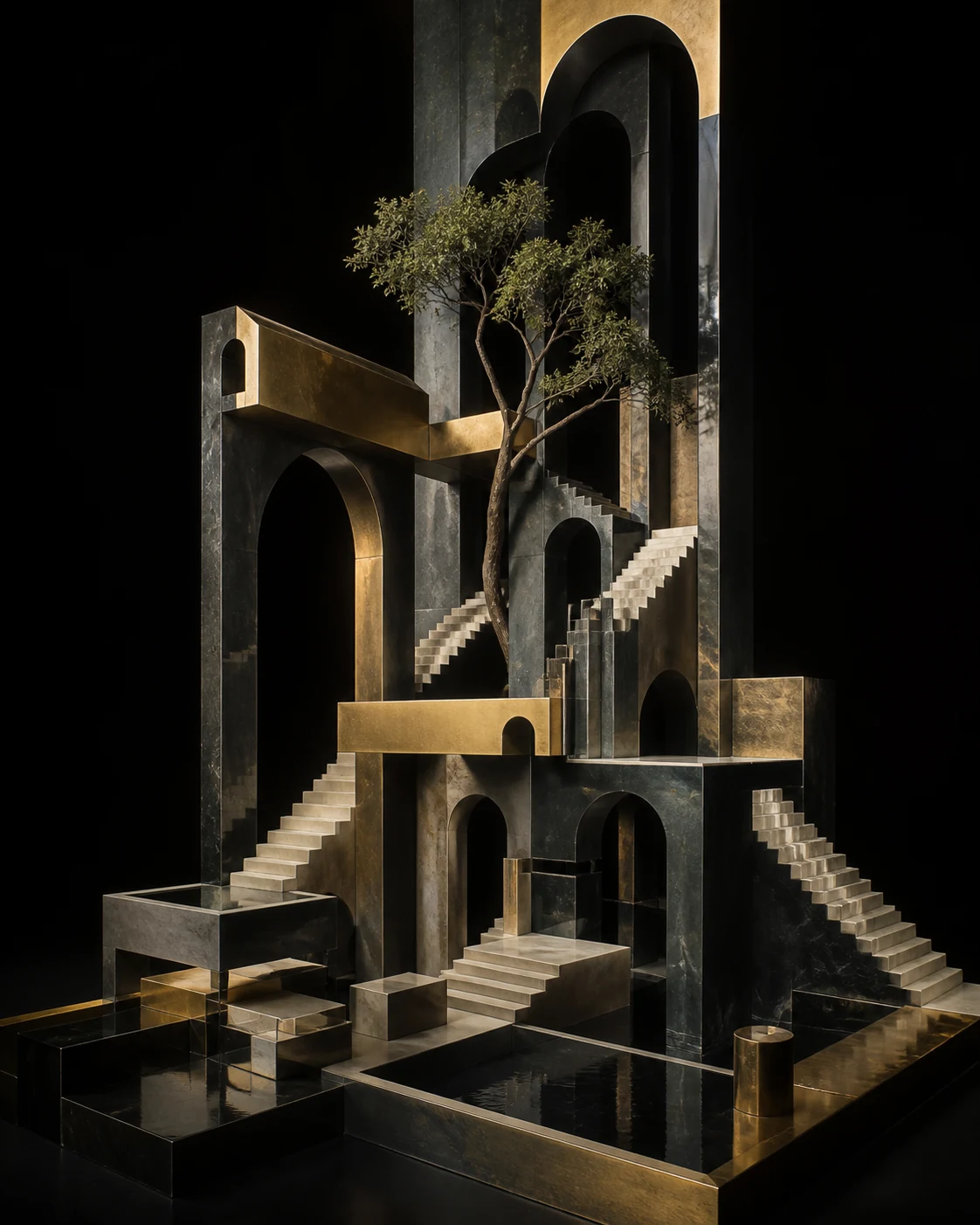
When Anja Vale received the commission for a new district school, she was given a survey of the site, a list of classrooms and the summer shadow of a hundred-and-six-year-old plane tree. The shadow had been measured at fifteen-minute intervals from sunrise to sunset and printed on transparent sheets. There were fifty-six of them.
The planning officer spread the sheets across Anja’s desk. As the hours advanced, the grey shape travelled over the empty site like the hand of an enormous clock.
PLANNING OFFICERThe school must fit outside this area.
Anja assumed he meant the trunk and roots. He meant the shadow.
As global warming made each summer hotter, the city began treating reliable shade as public infrastructure. The plane tree cooled the pavement, two bus stops and the upper windows of a retirement home. Removing it would increase summer temperatures across three blocks. Pruning its crown would be treated like narrowing a bridge.
Anja had trained in a city where landscaping arrived near the end of a project, after the drainage, access roads and profitable floor area had been settled. Trees were circles on a plan and green punctuation in a rendering. Here, the tree already occupied more of the brief than the building did.
Her first design placed the school along the northern edge of the site. It preserved the measured shadow, avoided the mapped roots and met every requirement. She presented it to the district engineer on a bright morning in March.
He took the model outside.
For an hour they watched wind cross the site. It struck the proposed entrance directly, lifted dust from the vacant ground and pressed it against the model’s tiny doors. Seeds from the plane tree collected in the recessed doorway.
DISTRICT ENGINEERChildren will spend half the year fighting that wind.
He did not reject the design. He asked Anja to leave the model overnight.
The next morning, damp marks crossed its cardboard floor. Rain had run from the model roof, pooled beside the entrance and escaped through the miniature assembly hall. The real ground sloped only four centimetres across the site—too little for Anja to notice while standing there, enough for water to notice immediately.
She rotated the school twelve degrees, raised one wing and opened a passage through the centre. The wind now passed between the buildings instead of striking the doors. Roof water travelled along stone channels toward the plane tree, where a broad planted hollow could hold it during storms.
The revised plan lost two classrooms.
Anja recovered them by moving the library above the dining room. The canopy shaded its western glass in summer. During winter, after the leaves fell, low sunlight reached the reading tables. Nothing about the arrangement looked symmetrical, but each room received what it needed at the season when it needed it.
Construction began in September. Before the foundations were marked, a soil crew excavated narrow trenches by hand to find the outer roots. The official survey was wrong. One root extended eleven metres farther east than expected, following a leaking water pipe beneath the former warehouse yard.
The contractor wanted to cut it. It was no thicker than his wrist, and the tree had thousands more.
The city arborist scraped away a patch of soil and showed them a pale line of new growth along its surface. The root supplied the youngest section of the crown—the branches that shaded the retirement home in late afternoon. Cutting it would not kill the tree. It would remove a particular hour of shade.
Anja moved a foundation pier.
That change forced a corridor to bend around the root trench. On paper, the bend looked wasteful. Built at full scale, it created a wide triangular recess between two classrooms. A teacher visiting the site stood there and said it was the first place in the plan where a child could be alone without being hidden.
They put a bench in it and lowered the window.
By spring, the building had walls but no finished skin. Swifts arrived from the south and began circling the exposed upper storey. The façade panels were stacked in the yard, each smooth and perfectly sealed. When the workers installed the first row, the birds repeatedly approached the ventilation gaps and turned away.
The foreman complained that the city could not redesign a school for every creature that flew past it.
Anja agreed. Then she noticed the insects.
They gathered in the warm air rising along the south wall. The swifts were not interested in the building; they were following a food route that existed because of its heat. Closing the façade would not remove the insects. It would force the birds to hunt them above the playground instead.
Anja replaced twelve upper panels with rough ceramic boxes open at the base. They formed nesting cavities away from the classrooms and cost less than the polished cladding they replaced. The foreman called them holes. By May, six contained nests.
The school was due to open in August. Two weeks before inspection, the city received the heaviest rain recorded in thirty years.
Anja went to the site at midnight. Water filled the street from curb to curb and entered the school grounds through the new central passage. For several seconds she believed the passage had been a mistake. Then the planted hollow beneath the plane tree began to fill.
The channels took water from the roofs. The sloping yard carried it away from the doors. The root trench, left with loose soil instead of concrete, absorbed the first surge and released it slowly into the hollow. Water spread around the tree’s broad surface roots and stopped several centimetres below the path.
Across the district, pumps failed and basement alarms sounded. The new school remained dry.
At three in the morning, Anja saw that the plane tree had dropped a large branch across the pedestrian entrance. It had fallen cleanly, without splitting the trunk. The branch would have shaded the front gate when classes began.
For the first time, the tree had made the building worse.
The next day, the contractor brought a saw. Anja asked him to wait. The fallen branch was healthy; wind had twisted it where an old pruning cut had weakened the joint. Its leaves remained green.
They removed the smaller limbs, milled the main section on site and made it into a long seat beneath the entrance canopy. The remaining wood became shelves for the library. The school lost an hour of morning shade, so Anja extended the canopy with adjustable slats. The solution was not as efficient as the living branch. It did, however, allow the entrance to stay usable while the tree grew a replacement.
The school opened eleven days late.
On the first morning, children followed the water channels before they followed the signs. They found the corridor bench, pressed their faces to the low window and counted six swift nests above the dining hall. In the library, a girl ran her hand along a shelf and discovered the dark oval where a branch had once joined the trunk.
She asked Anja why the school had been built around so many things.
ANJABecause they were here when we arrived.
The answer was true, but incomplete. The school had not merely spared the tree, the water and the birds. Each had altered the building. The wind had opened its centre. Rain had shaped its ground. A root had bent its corridor into a place for solitude. Swifts had changed its walls. Even the broken branch had entered the rooms as furniture.
During the first year, teachers learned to expect seasonal changes. In autumn, leaves covered the water channels and classes cleared them together before storms. Winter sun warmed the library until noon. In spring, one side of the playground closed briefly while young swifts practised leaving their nests. Summer lessons moved beneath the plane tree, where the temperature stayed six degrees lower than on the street.
The building was not effortless. Gutters needed clearing. Ceramic nest boxes needed inspection. Roots lifted two paving stones beside the dining terrace. Maintenance workers reset the stones with wider joints, leaving room for the next year’s growth.
Five years after opening, Anja returned to prepare an extension. The plane tree had closed the gap in its crown. Its new shadow reached the entrance again, but not in exactly the old shape. She placed fresh transparent sheets over the original plans and traced it.
The extension would begin there—not with the rooms the school wanted, but with the conditions already making life possible. Anja sharpened her pencil and waited for the wind to show her where the first door should not go.