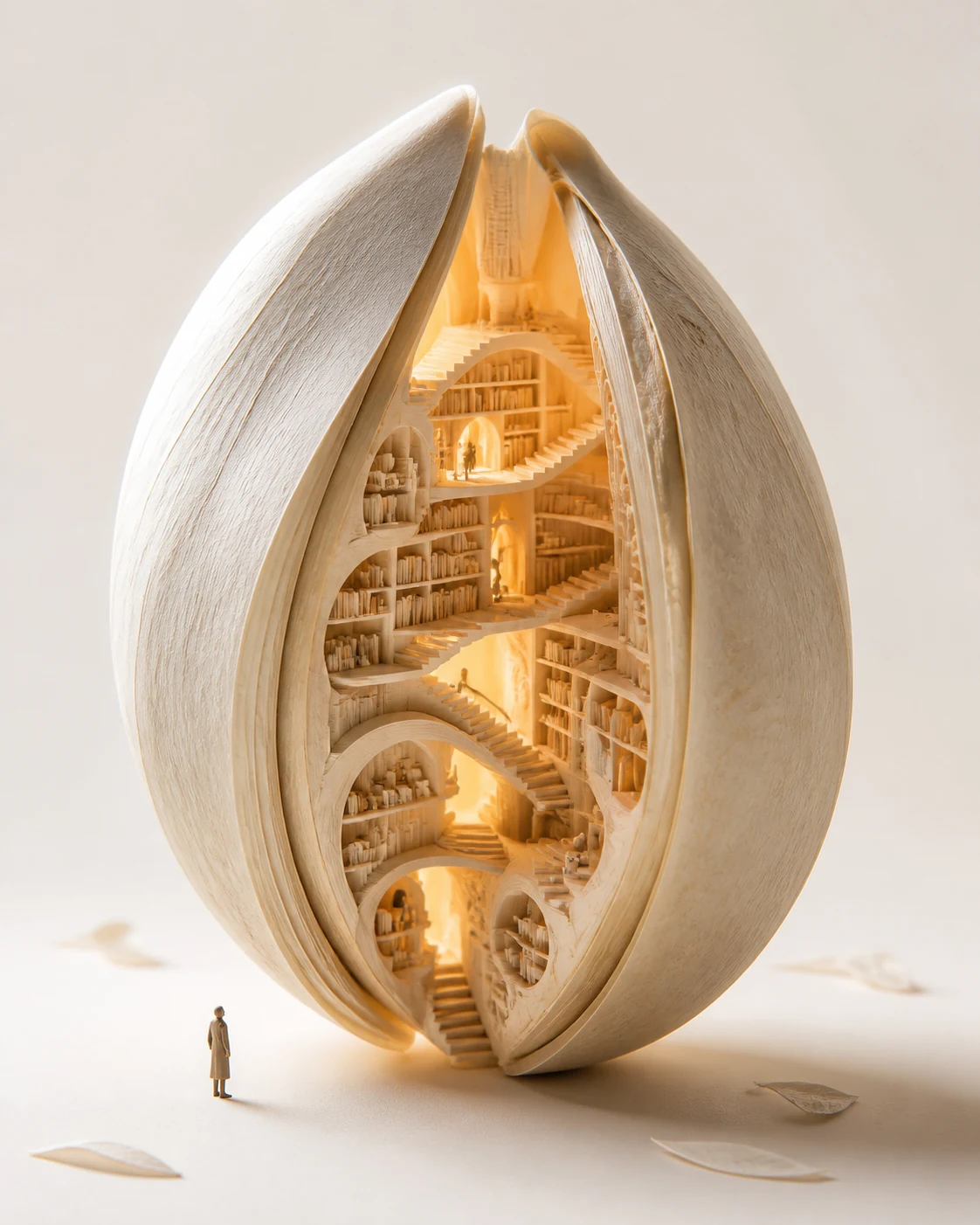
The book arrived at the returns desk without a title, an author or a material anyone could identify.
Edda found it beneath the ordinary Monday pile: cookbooks freckled with oil, a detective novel swollen by bathwater, three volumes on municipal drainage and a picture book whose final page had been repaired with silver tape. The unknown book was smaller than her hand. Its cover felt like warm bark. When she opened it, the pages gave off the clean mineral smell of rain striking stone.
The Interlibrary Office had procedures for unidentified objects. Edda measured the spine, photographed the binding and placed it beneath the catalogue lens. The machine scanned the book for several seconds, printed seven destination slips and shut itself down.
Each slip named a different library.
Her supervisor read the seven destinations twice, then arranged the slips in a circle.
SUPERVISORTake it to the first address. Someone there may recognize it.
EDDAWhich address is first?
SUPERVISORThe machine seems to have left that for the libraries to decide.
By noon Edda was standing inside the oldest living tree in the northern park. The entrance opened between roots broad enough to contain apartments. Readers removed their shoes before crossing the threshold; vibration disturbed the smallest seed drawers, and a dropped heel could rearrange an entire meadow.
The tree librarian held the book against her ear. Somewhere inside the cover, something clicked. Edda looked again at its blank pages.
TREE LIBRARIANIt contains a dormant orchard.
EDDAIt contains no words.
TREE LIBRARIANWords are a very recent storage method.
The librarian opened a narrow drawer and removed one seed no larger than punctuation. She pressed it into the book’s binding. A line appeared on the first page: The pears were hard that summer, but we ate them before leaving.
The tree refused to catalogue the volume. Whenever the book touched the inner wall, sap withdrew from that part of the trunk and the branches above began to bend toward the exit. The librarian advised Edda to leave before they closed around her path.
The second slip brought her to an inland sea. A lift carried her through green water to a reading room bolted to the lake floor. Books there were copied onto thin mineral sheets; ordinary paper softened and came apart within hours. Readers worked in forty-minute intervals between pressure checks, so every question had to be chosen before descent.
The submerged librarian placed Edda’s book beneath a lamp. Salt crystals formed across its cover, tracing the outline of a vanished shoreline. He read the new sentence and shook his head.
SEA LIBRARIANI don’t know the orchard. But these people left from our shore.
He added a translucent stone page. Against it appeared the faint impression of seven people walking into shallow water while a boat waited beyond the reeds. No faces were visible. The image had been made from pressure rather than light.
The volume still did not belong there. When sealed in a dry case, it began producing the sound of waves.
Edda carried it to the railway platform named on the third slip. No timetable listed the train, but at 16:03 an engine arrived with paper windows and no fixed destination. Its carriages contained unfinished maps: coastlines interrupted by doubt, roads ending where their makers had turned back, blank regions preserved with the same care as capitals.
The conductor opened the book on his ticket machine. A route drew itself across the mineral page, beginning at the drowned shoreline and dividing into seven lines. Six faded. One continued beyond the edge.
CONDUCTORThis route is in our archive, but it has no date.
EDDAHas the book travelled with you before?
CONDUCTORPerhaps. Our maps preserve uncertain journeys as carefully as completed ones.
He punched a small crescent into the destination slip and returned the book. Outside the paper window, the station had already begun to disappear.
By evening the volume was heavier. Its blank pages had begun whispering whenever Edda passed an open doorway. The fourth address led to a library without visible books. Visitors sat beneath copper funnels while archivists released preserved sounds into the room: the last bell of a demolished school, a language spoken in sleep, ice moving through a harbour before winters became mild.
The sound librarian asked Edda to close her eyes. He opened the volume.
A kitchen emerged around them. Knives struck a board. Someone fed wood into a stove. Seven people spoke at once, not urgently, but with the crowded ease of a family that assumes there will be another meal. Beneath their voices, pears rolled across a table.
Then came a knock. Chairs moved. The recording ended before the door opened.
Edda kept her eyes closed until the librarian touched her sleeve.
SOUND LIBRARIANIt cannot stay here. Every recording in this library has a date. This one is still waiting for its ending.
The fifth library occupied a weather station on a mountain where forecasts were stored after they failed. Its shelves held summers that had been promised rain, storms that turned aside and winters remembered as harsher than any instrument confirmed. The archivist placed the book in a glass chamber. Inside, the temperature fell. Frost appeared along the spine while the pages filled with a pressure pattern from a storm that had never arrived.
For a moment, the unknown kitchen smelled of wet coats. The family’s unheard visitor had brought weather in from somewhere else.
Edda no longer believed she was carrying seven books mistaken for one. Each library recognized a different layer of the same memory, yet none could keep the volume without treating everything outside its specialty as irrelevant. The problem was not identifying the book. It was finding a catalogue broad enough to hold a place as it had actually been lived.
The sixth address was an unmarked shop between a perfumer and a locksmith. Its catalogue preserved extinct smells in black ceramic jars. The librarian wore no perfume and spoke through a scarf. She turned the book’s pages beneath a glass hood.
The room filled with pear skin, woodsmoke, lake mud, wool drying beside a stove and the metallic scent of a key held too tightly. Edda recognized none of them, but together they produced the sharp grief of remembering a place one has never visited.
The scent librarian found a number written beneath the rear binding. It corresponded to a village removed from every civil map eighty-three years earlier, when the inland sea rose over its orchards. Seven families had left. Only six appeared in the resettlement records.
EDDAThe seventh family did not disappear.
SCENT LIBRARIANNo. They became difficult to store.
The final destination slip contained no address, only the instruction RETURN AFTER SLEEP. Edda took the book home. She placed it on the kitchen table, ate standing at the sink and resisted opening it again. At midnight the cover cooled. At one, something inside turned a page.
She dreamed of a library that existed only while someone was dreaming of a room they had lost. Shelves rose from dark water. Their books were not records of events but complete places waiting to be inhabited: a stair at a familiar angle, a patch of afternoon on a wall, the exact resistance of a swollen door in winter.
At the centre sat the seventh family, still eating unripe pears. They were not ghosts. Ghosts know they have been left behind. These people were held in the instant before the knock, protected from the knowledge that the village, kitchen and orchard had already become past tense.
A child at the table looked directly at Edda.
CHILDAre you here to wake us?
Edda had no answer that would not destroy the room.
She woke with her hand resting on the book. It now had a title: On Returning What Cannot Return. Beneath it appeared a due date eighty-three years overdue.
At the office, her supervisor prepared an acquisition form. He left the owning institution blank.
SUPERVISORWhich library gets it?
Edda looked at the seven marked slips, the seed in the binding, the mineral page, the crescent punched by the impossible train. Giving the volume to any one library would preserve a fragment and classify the rest as damage.
She stamped it IN TRANSIT.
The book still travels. It spends spring inside the tree, summer beneath the sea and several uncertain weeks aboard the map train. It is listened to, weathered and opened beneath the scent hood. Once each year it disappears from the catalogue entirely. During that night, somewhere, a reader dreams of a kitchen and keeps the seventh library open.
No institution owns the book. Every institution performs part of remembering it.