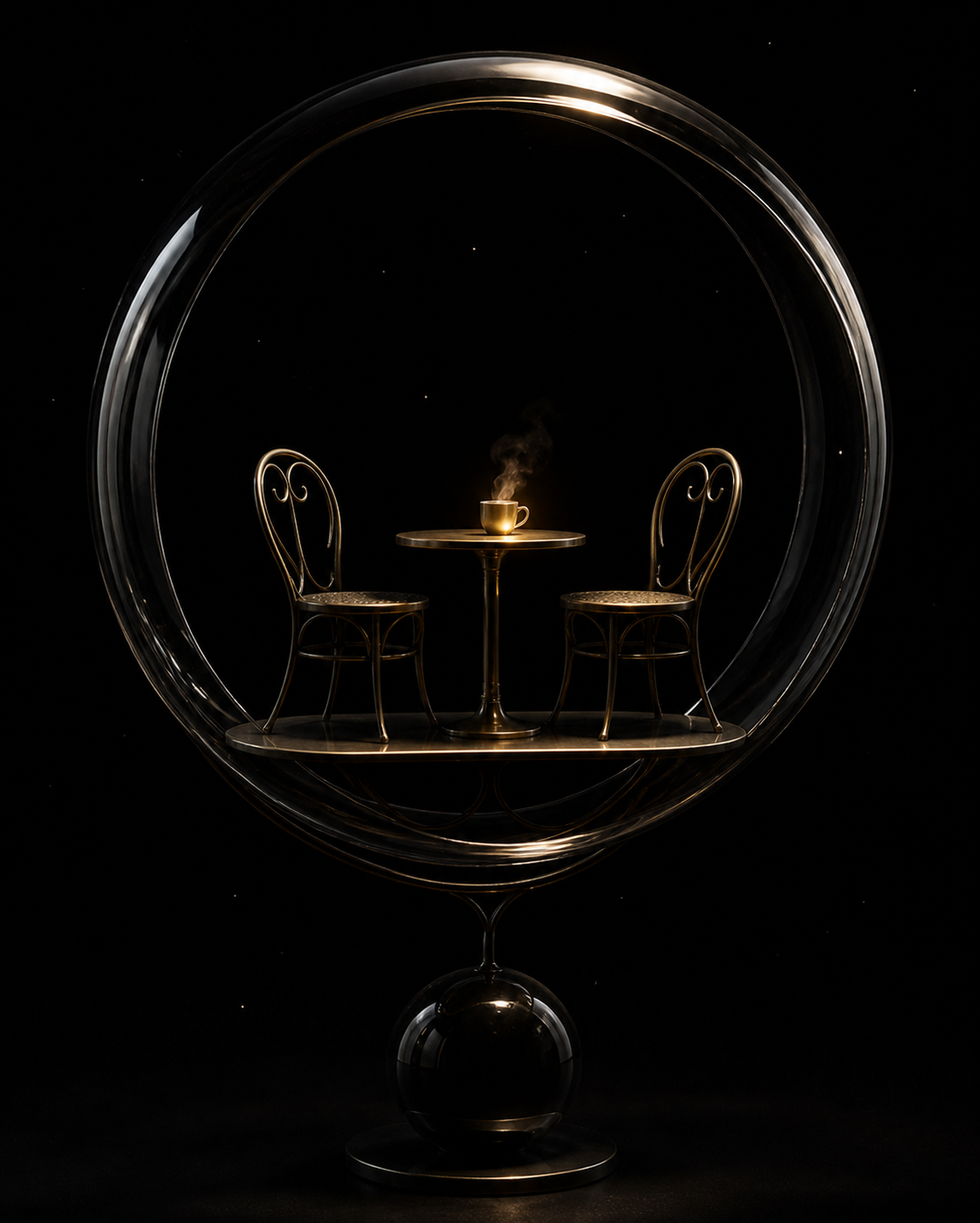
At closing time, something knocked on the window from outside the universe.
Orin had just turned the sign to SLEEPING. He preferred this to CLOSED because closed sounded permanent and the café had survived too many predictions of permanence. He was carrying the last two cups toward the sink when the knock came again: three soft taps against glass designed to withstand a collision with a moon. Beyond it there were no stars. That was why travellers stopped here—six tables, a brass coffee machine and one impossible view of the place where light became too old to return.
Orin set down the cups as a hand appeared against the other side of the glass. It wore a glove the colour of unpolished bone. Behind it floated the suggestion of a person, visible only where the café’s warm interior reflected from a visor. No ship, tether or docking light accompanied them. The figure knocked a fourth time, almost apologetically.
There was no door on that wall, but Orin opened one anyway. The stranger entered without wind. For a moment gravity seemed uncertain about the coat, which folded upward around the shoulders before remembering where the floor was. Frost covered the visor from within. When the helmet came off, Orin saw a woman who might have been thirty or eighty; long travel had made age look less like a number than a material. Her hair had been cut with a blade and no mirror.
ORINKitchen’s finished.
STRANGERIs there tea?
ORINThere is always tea.
This was not strictly true. There had been no tea during the helium shortage, and once a wedding party from the Perseus routes had consumed everything except a packet labelled Calming Blend, which nobody trusted. But rules spoken to a frozen visitor become architecture. Orin filled the kettle while the woman chose table four, nearest the window. Departing travellers usually avoided it until their final minutes. From there, the dark did not resemble night. Night is darkness with a morning arranged behind it; this was distance without a promise.
Orin placed a heavy cup before her. She wrapped both hands around it, but did not drink.
ORINWhere is your vessel?
STRANGERBehind me.
ORINBehind you is the observable limit.
STRANGERThat is what your side calls it.
The café had hosted pilgrims, surveyors, deserters and wealthy people trying to purchase an emotion unavailable nearer home. Orin had learned that extraordinary guests generally wanted ordinary service. He did not ask how she had crossed the glass. Instead he found bread, warmed it against the side of the coffee boiler and took a paper tab from beneath the counter.
ORINDo you have a name?
STRANGERSeveral. Most have expired.
ORINI only need one for the bill.
STRANGERThen write Senn.
He wrote the name on the tab. The café used paper because electronic accounts behaved nervously near the boundary, and because a handwritten debt is more intimate and therefore more likely to be paid. Senn drank. Her expression changed almost invisibly.
ORINSomething wrong?
SENNNo. It is hot.
ORINThat is generally the arrangement.
She laughed once, then looked startled by the sound. On the wall above the counter hung photographs of people about to leave. Orin never photographed the departures themselves. The images showed hands around cups, coats folded over chairs, crumbs and an unfinished game—the small domestic evidence that a person had occupied space before choosing an immeasurable distance. Senn studied the photographs while Orin polished a spoon that was already clean.
SENNThey all went outward?
ORINEvery one.
SENNWhy?
ORINReasons improve with retelling. Curiosity. Exile. Research. Love.
SENNThose are four different directions.
ORINNot from here.
A transit light crossed the far edge of the window. Somewhere beyond sight, a vessel was approaching the final channel. Its engine appeared as a white point, held for several seconds and vanished. The café lights dimmed automatically in respect. Senn watched until the glass reflected only the room, then spoke again. Orin stopped polishing.
SENNOn my side, we tell stories about this light.
ORINWhat kind of stories?
SENNStories in which the darkness ends. Beyond it are rooms where heat stays in cups, and strangers leave food without asking what century you were born in. Our children draw the stars crowded together. They think abundance must look untidy.
ORINThere are untidy parts.
SENNI hoped so.
She ate the bread slowly, beginning with the crust. Orin recognized the method of someone who had learned not to trust the arrival of another meal. When he asked how far she had travelled, Senn placed one palm flat on the table.
SENNFar is measured from somewhere. We lost somewhere.
The kettle clicked as it cooled. For two hundred years the café had called itself the last warm room. The phrase appeared on old route maps and the aprons of employees who had since retired to planets with weather. Travellers repeated it fondly. Orin had always taken last to mean brave, a lamp kept at the far end of human reach. Now the word sounded like a locked door.
ORINAre others coming?
SENNIf I return.
ORINYou crossed all this for tea and toast?
SENNI crossed to see whether tea and toast were lies.
Orin looked around the room and poured more tea. Table two rocked slightly because the floor had settled. The sugar bowl had a repaired crack. Near the ceiling, a ventilation fan made a sound like somebody breathing through sleep. Nothing in the café could support the burden of being proof that the universe was hospitable.
Senn told him little about the dark. Language had travelled poorly there. Directions detached from objects; clocks disagreed until people stopped asking them to vote. Her community lived aboard structures assembled from vessels whose original destinations no longer mattered. They collected faint transmissions from the bright universe: weather reports, recipes, fragments of courtroom testimony, advertisements for products extinct before the message arrived.
From these scraps they had invented entire civilizations. In one version, humans spent most of their lives choosing breakfast. In another, rain was manufactured exclusively for music. Cafés appeared in nearly every reconstruction because cups were often mentioned beside conversation, and conversation seemed to be how people repaired distance.
SENNSometimes we received only one side of a conversation.
ORINWhat did you make of the missing side?
SENNWe assumed the absent person was the important one.
Orin thought of all the evenings he had half-listened to travellers speak into the dark, addressing people who would receive their words years later or never. The universe was apparently full of absent people becoming significant by accident. Above the sink, the clock reached an hour for which it had no numeral, and Senn stood.
ORINYou can stay until morning.
SENNDoes morning happen here?
ORINEvery eighteen hours. We lower the lights and serve eggs.
SENNThen it is real.
She put on her coat. At the window, the door reappeared as a narrow line, and Orin handed her the paper bill.
SENNI have none of your currency.
ORINBring someone back.
SENNThat may cost more.
ORINIt usually does.
Senn folded the bill, placed it inside her glove and stepped across. The coat forgot gravity first, then the rest of her. The door closed without sealing. For a while Orin could see nothing; then, impossibly far away, a small red light blinked twice.
He returned to the counter and turned the sign around. SLEEPING faced the room. OPEN faced the dark.
The café was no longer the last cozy place in the universe. It was the first one from the other direction.