The sea rose nine hours early the night before Tala left the Moon.
She noticed because her farewell table had been set on the lower promenade, where the tide was not due until morning. The bakery had delivered a lemon cake. Her grandmother had brought the blue cups used for departures, and six neighbours were fastening paper lanterns to the rail. Beyond them, the water should have been descending toward the algae terraces.
Instead, a dark line passed over the first white step.
The lanterns trembled as everyone lifted the table together. By the time they reached the upper walk, three steps had disappeared. No alarm sounded. The pumps beneath the eastern quay were silent, and the tide display still promised LOW WATER — 22:00.
Tala stood at the rail with the cake in her hands. The sea did not rush or break. Under lunar gravity, each wave raised itself slowly, considered the stone and folded over with the patience of cloth. She had watched those waves every day of her life. She had never seen one arrive without permission.
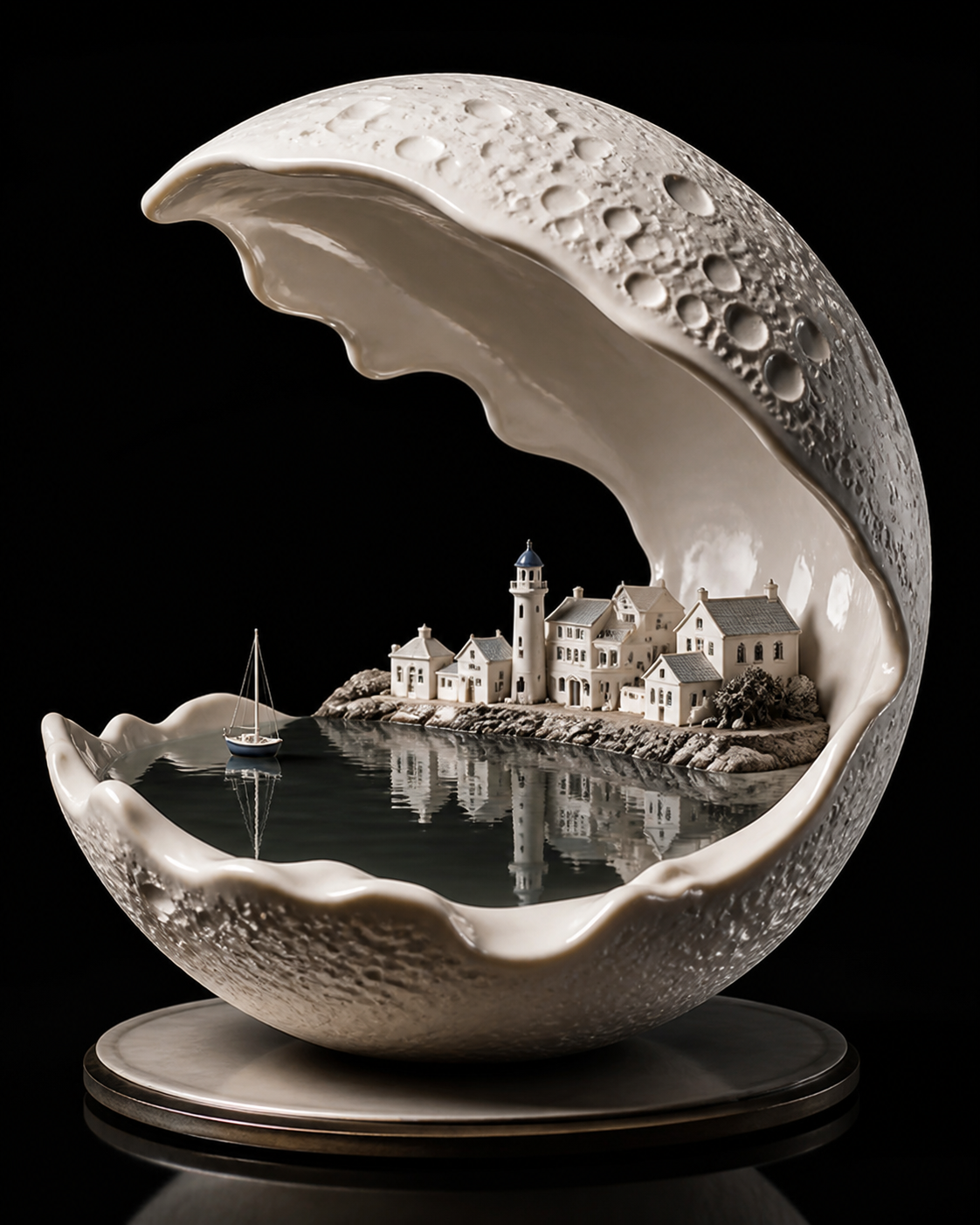
The town occupied the inner slope of a sealed crater. White houses descended in narrow rows toward the water, their roofs curved against pressure and dust. Above them, the transparent canopy held a black sky in which Earth remained suspended over the western rim. At night the planet’s light passed through the dome and lay across the sea like a second, narrower road.
The reservoir had been made from ice mined beneath the southern plain. It cooled the settlement, supplied its kitchens and greenhouses, and carried long rafts of algae that renewed part of the air. Twice each day, pumps shifted the water across the basin. The artificial tide washed nutrients through the terraces and prevented warm layers from gathering near the surface.
Residents had built habits around the machinery. Children learned to swim during high water. Older people crossed the exposed terraces at low water, using the maintenance paths as a second promenade. Birthdays were remembered by tide height. The lighthouse on the northern quay guided the small service boats during the long lunar night, when the town dimmed its dome and the shore became difficult to distinguish from the sky.
That evening the lighthouse beam found water where stone should have been.
The sea continued rising for another forty minutes. It stopped below the upper walk, leaving the farewell lanterns reflected in a place where Tala had expected chairs. Across the basin, the opposite shore had withdrawn. Pale terraces emerged one after another beneath the hanging Earth.
Only that side, Tala realised, had gained water. The entire surface had tilted west.
Technicians closed the lower streets and checked the pumps. The town waited behind the rails while instruments moved along tracks beneath the quay. No pipe had opened. No retaining wall had shifted. The quantity of water had not changed. It had simply chosen a different level on opposite sides of the basin.
Earlier that afternoon, Tala had watched a sealed container arrive from Earth. It held twelve litres of Atlantic water: a living sample intended for the marine laboratory. The scientists wanted new plankton, salt-tolerant bacteria and whatever microscopic negotiations had kept an ocean alive for longer than human history.
As the canopy filters darkened for the town’s evening, the sample had been poured into the reservoir.
Twelve litres among millions should have vanished. Instead a silver disturbance had travelled from the laboratory inlet to the centre of the basin. Tala had followed it from the tram, watching the surface tighten in a line too straight to be wind. At the time she had thought the sea was reflecting a cable beneath the dome.
Now that line pointed directly toward Earth.
The technicians restarted one pump. Water moved east for several metres, shivered and returned west. A second pump produced the same result. The sea accepted the machinery’s force and then calmly undid it.
By midnight the town had stopped calling the event a malfunction. The laboratory compared the movement with Earth’s position and calculated a cycle just over twenty-seven days long. The reservoir was responding not to the town’s clock but to the slow change in the planet’s pull as the Moon rocked slightly in its orbit.
The imported water had not added enough mass to matter. It had brought a pattern. Somehow the pattern passed from one body of water to another until the whole basin behaved as though it remembered a much larger shore.
Tala’s grandmother remained at the upper rail after the neighbours carried the untouched cake home. She had lived beside the basin before it reached its present size. In those years the western houses stood farther down the crater, around a reservoir narrow enough to cross by footbridge.
By two in the morning, safety crews had mapped the newly exposed eastern terraces as far as the old foundations.
The town opened one guarded path across the dry basin. Tala and her grandmother joined the residents descending in soft-soled shoes. The floor was not sand but pale mineral grit patterned by the retreating water. Algae shone in the channels. Small maintenance machines lay still between the terraces, their wheels beaded with droplets.
They walked beyond the familiar low-water mark. The air smelled of salt from the Earth sample, though no instrument could find enough salt to explain it. Ahead, rectangles appeared in the basin floor: the first streets, sealed beneath water when the reservoir expanded.
Tala’s grandmother stepped over a threshold with no wall around it. She placed the blue departure cup on a surviving ledge. The ledge had once been their kitchen window.
Nothing else remained of the room. Water had rounded the corners of the foundation and filled the fastening holes with green threads. Tala had seen photographs of the original dwelling, a narrow metal unit with four bunks and a table that folded into the wall. Standing inside its outline, she found it smaller than the storage room in her present apartment.
Her grandmother moved through the vanished rooms without hesitation. A change in the floor told her where a door had been. Two bolts marked the bed. Near the outer wall she found a shallow groove worn by the first family’s water containers.
Tala understood then that the town had not begun beside the sea. The sea had grown through the town. Houses had moved uphill, paths had become terraces, and the water had covered the first definition of home without erasing it.
The westward tide paused before dawn. Along the upper promenade, workers marked its highest point with a blue ceramic line. On the eastern basin floor, residents collected nothing. They photographed the foundations and left every object where the water had returned it.
Tala retrieved the cup from the old window ledge. A thin ring of salt had appeared inside it.
Her departure shuttle lifted eleven hours later. Through the small window, the crater canopy flashed once and became indistinguishable from the surrounding plain. Earth expanded ahead of her, blue enough to look excessive. Tala had spent years preparing for its gravity, weather and uncontained distances. She had not prepared for the amount of water.
One lunar tide later, she stood on an Atlantic shore.
The ocean had no pressure wall. It continued past every structure intended to frame it. Wind tore pieces from the surface and threw them against the beach. Tala kept waiting for the waves to slow into the long, deliberate folds of home, but Earth’s gravity broke them too quickly.
Her wrist display carried the first provisional tide table issued by the crater town. The pumps still circulated the deep water, but they no longer determined the shore. Lower streets were being rebuilt. The algae terraces had shifted east. Residents had voted to leave the old foundations uncovered during the lowest part of each cycle.
At 16:18, the Atlantic began to withdraw from Tala’s feet.
She checked the lunar table. At that same minute, beneath the distant crater dome, water was reaching the blue line on the western promenade.
Tala took from her bag the blue cup her grandmother had placed on the old window ledge. She held it in the wash of a receding wave. For a moment, it contained an ocean pulling away from her while the sea at home rose toward Earth.