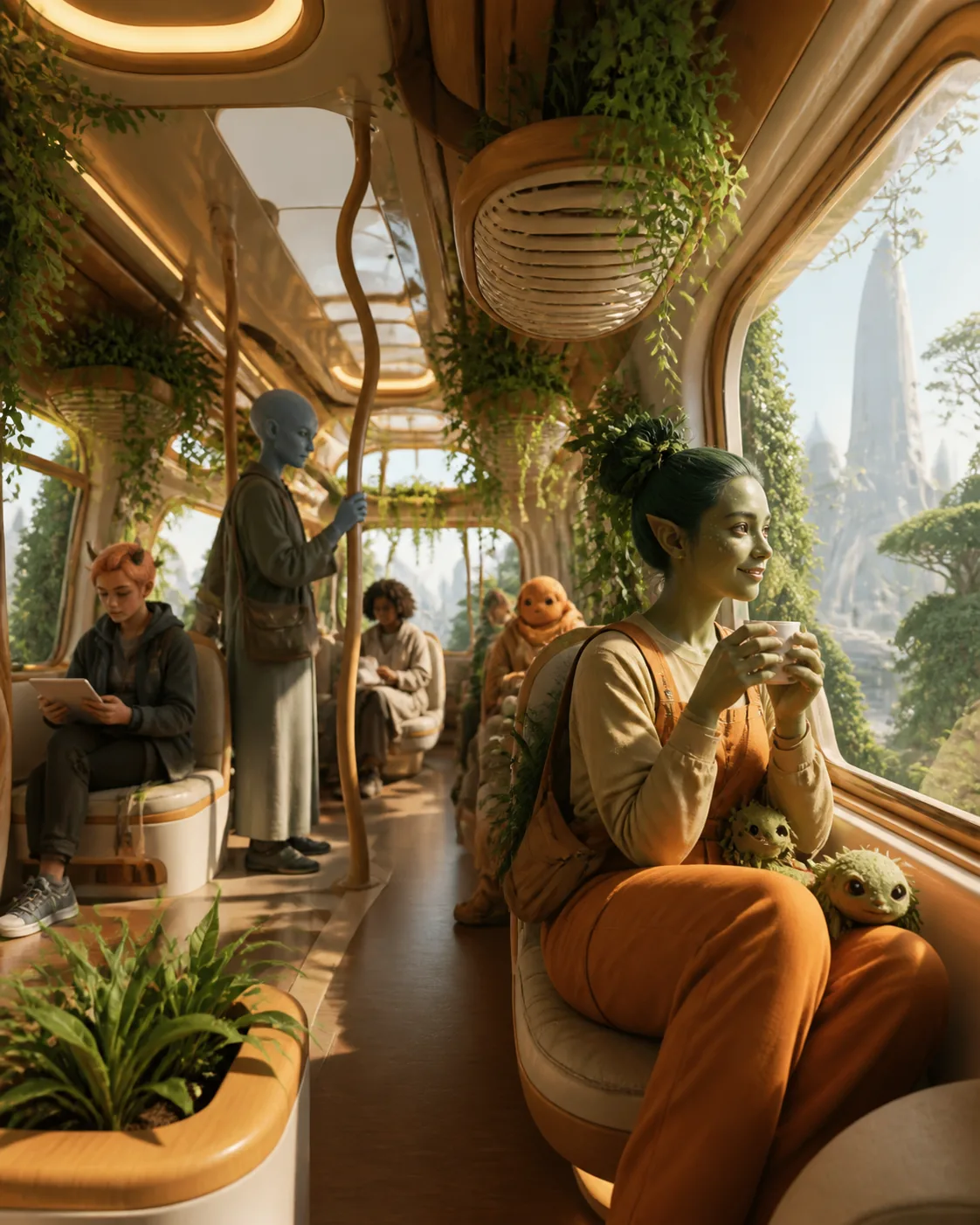
Nothing flies past the bedroom window. No transparent screen announces the weather. The future begins with Mara waking at seven because the room stayed cool through the hottest night of the year.
She notices the absence before she understands its cause: no compressor coughing in the courtyard, no sheet stuck to her skin, no message asking her to reduce consumption for the good of the grid. Exterior shutters closed while the western wall was still in shadow. Water beneath the building carried yesterday’s heat into stone. Someone planned this sequence years ago, and this morning it requires no virtue from her.
The kettle is ordinary. It has one switch and a replaceable heating coil. Electricity arrives from a network clean enough that making tea is not presented as a private ethical examination. On the kitchen table, a peach has softened overnight. Mara eats it over the sink and watches juice run across her wrist. Optimism, at this hour, tastes less like progress than like fruit that was allowed to become ripe near the place where it will be eaten.
Downstairs, the lift is being inspected. A handwritten card gives the technician’s name, the expected delay and a number answered by a person. The lift still works, but its doors have begun closing unevenly. In earlier years, maintenance happened after failure and was described as an emergency. Now the building treats a strange sound as information rather than destiny.
Mara takes the stairs and meets Mr. Okafor resting on the second-floor landing. The seat built into the handrail has unfolded beneath him. It was not installed as a special adaptation; every landing has one. They talk for three minutes about the heat. Neither has to pretend the pause is accidental.
Outside, the street smells of wet soil although it has not rained. Trees receive water captured from showers and laundry, cleaned in a basement system whose pipes remain visible behind glass. A small label names the gardeners responsible for it. The city once hid maintenance behind decorative panels, as if care reduced the magic. Now children can follow the blue pipes and understand why the leaves remain alive in August.
At the corner, delivery vans are gone. They used the curb before seven, when the street belonged temporarily to unloading, repairs and waste collection. The same strip now belongs to bicycles and wheelchairs. A bakery rolls out two tables. Public space changes purpose without pretending every need can occupy it simultaneously.
A school group waits at the crossing. The signal gives them eight seconds more than an efficient traffic model once recommended. Those eight seconds make room for a child tying a shoe, an older neighbor pulling a cart and a teacher counting heads without panic. Cars wait. Nobody describes this as innovation, though it required years of argument to decide whose minutes mattered.
Mara’s phone has died. The bus stop still tells her when the bus will arrive. A physical map shows where it goes. Beneath the timetable, a narrow shelf holds three paper tickets for anyone unable to pay digitally; passengers replace them when they can. The arrangement is imperfect and occasionally exploited. The city kept it because a system that survives only perfect behavior is another name for a trap.
The bus arrives two minutes late. Its driver apologizes out of habit, then corrects himself: a passenger needed the ramp at the previous stop. Delay has not disappeared from the future. It has acquired reasons that can be spoken without shame.
Through the window, Mara sees a crew opening the pavement around a young tree. One worker measures the soil; another enlarges the square so the trunk will not eventually split the stone. Their uniforms carry names rather than corporate slogans. Children stop to watch. The crew is not rendered invisible to preserve an image of a finished city. A functioning place is permitted to show its hands.
At the clinic where Mara works, the waiting room contains fewer chairs than it did last year. This is good news. Appointments are longer, schedules contain empty spaces for emergencies, and nurses can solve some problems by phone. The wall display does not congratulate the institution for efficiency. It shows average waiting time and the number of staff absent, so frustration has somewhere accurate to go.
Before beginning her shift, Mara opens a high window. Warm air rises into a planted courtyard where insects occupy the flowers with professional concentration. Somewhere below, the lift technician closes a toolbox. A bus kneels toward the pavement. A gardener clears a filter that caught the grit from hundreds of showers.
No single object in this morning would survive as the hero of an exhibition. There is no silver tower, domestic robot or miracle material. The future has entered through standards, schedules, shade, wages, repair access and an extra eight seconds at a crossing. Its inventions are agreements made durable enough to feel like weather.
This is why the morning is optimistic. Not because everything has been solved, and not because disaster has become unimaginable. Heat will return. Machinery will fail. People will argue about the curb. Hope resides in the city’s willingness to notice ordinary harm before it becomes a private catastrophe—and in the quiet evidence that somebody, somewhere, has been paid to care for what everyone uses.