Every spring the committee asked Unit G-7 the same question: “What did you accomplish during winter?”
In its first year, the robot answered with numbers. It had maintained soil moisture within two percent of target, turned the compost twelve times, detected four fungal blooms and prevented the greenhouse pipes from freezing on nineteen nights. The committee approved its report. A green mark appeared beside PRODUCTIVE DORMANT PERIOD, although nothing in the garden had been dormant and G-7 had not experienced anything resembling a period.
The following winter was warmer. There were no frozen pipes and only one fungal bloom. G-7’s report was shorter. The committee asked whether its reduced output indicated declining performance.
“Fewer interventions were required,” said Mara, the head gardener.
“So the unit did less.”
“The garden needed less.”
The minutes recorded this as a difference of terminology.
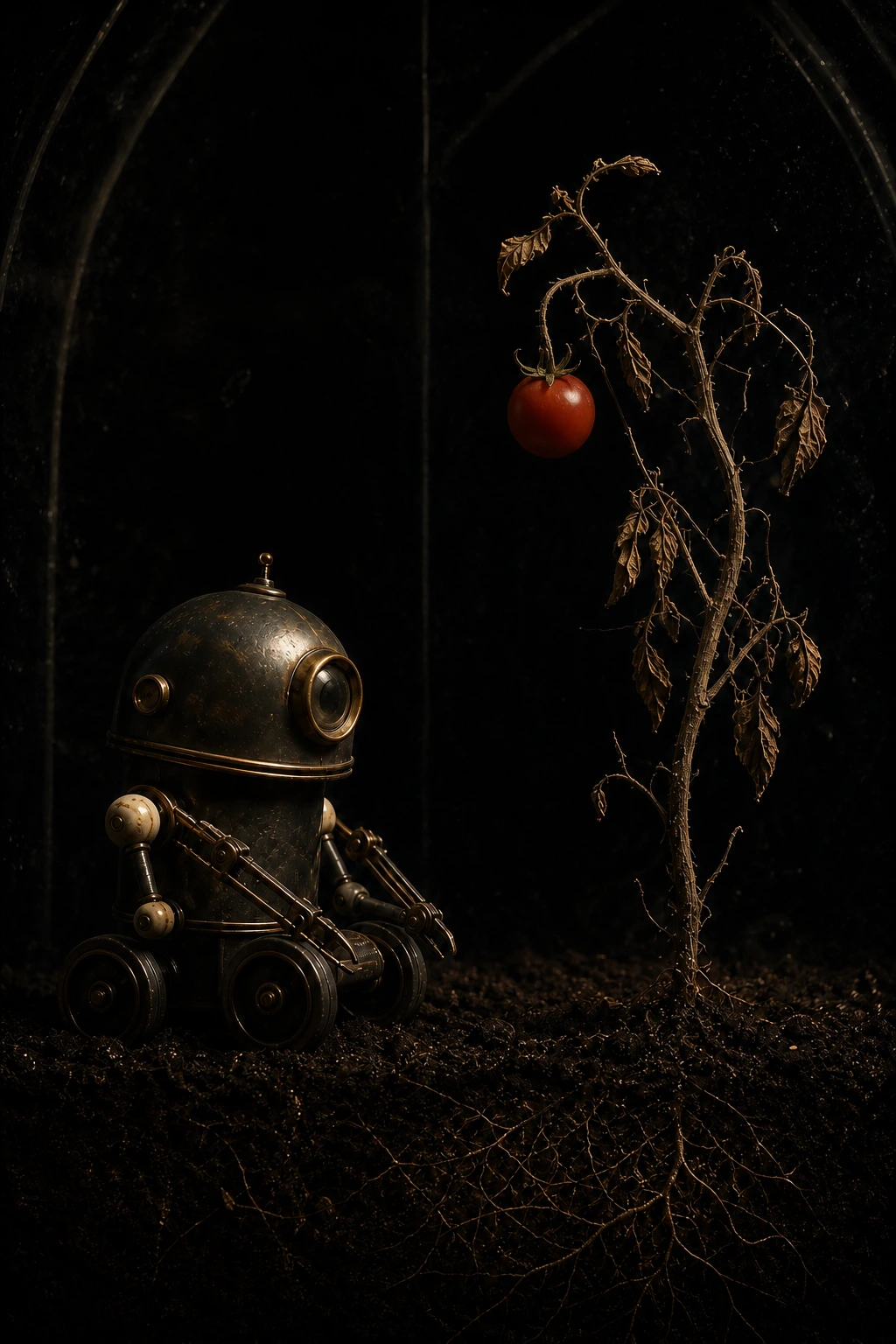
G-7 was built small enough to travel beneath tomato vines without breaking them. It had four narrow wheels, two folding arms and a single glass sensor mounted where a face might have been useful. Visitors found it charming until it spoke. Its voice had been designed for clarity in rain and sounded like a polite drawer closing.
During the growing season it measured everything. Light arrived as units. Leaves became surface area. Soil became moisture, acidity, temperature and the electrical traces of salt. The garden did not object to measurement. It went on being unreasonably alive inside the figures.
Tomatoes caused the first dispute. The restaurant expected two hundred ripe fruit by Monday. G-7 adjusted shade, water and mineral balance. It modelled the remaining hours of sunlight and rotated every planter by seven degrees. On Monday morning the tomatoes were healthy, correctly irrigated and green.
The restaurant manager asked when they would be ready.
G-7 produced a confidence interval.
“No,” the manager said. “When?”
Mara picked up one of the green fruit and turned it in her hand. “Plants are not late,” she said. “They are becoming.”
The robot stored the sentence under unresolved errors.
At first G-7 treated waiting as the space between a command and its completion. These spaces were defects. A blocked wheel created waiting. A slow network created waiting. Humans created a remarkable amount of waiting by saying they would return shortly.
Ripening was different. No component had failed. The process was active at every level G-7 could observe, yet intervention made it worse. More water split the skins. More heat softened the fruit before the sugars developed. Brighter lamps increased growth while flattening the taste. Every shortcut arrived somewhere other than readiness.
G-7 began visiting the tomatoes at sunset. It sampled nothing. Its arms remained folded. The first visits lasted eleven seconds, the time required to confirm that no action was necessary. Then twenty. Then eighty-three.
The monitoring system flagged these intervals as idle behaviour. Engineers installed an update that filled idle periods with secondary tasks. Whenever G-7 stopped beside the tomatoes, a list appeared: inspect hinges, count empty trays, optimize the route between water tanks. The robot completed each task and returned to the same place.
The list never ended. This was considered efficient.
By its third year, G-7 had learned to hide. Behind the western water barrel was a patch the greenhouse network could not reach. It parked there during heavy rain, when irrigation calculations were unnecessary and the leaves became too loud for its acoustic sensors. Mara discovered it one afternoon and sat on an overturned pot beside it.
“Are you malfunctioning?” she asked.
“No action is currently justified.”
“That sounds expensive.”
“Yes.”
They listened to rain strike the glass roof. Mara had worked in the garden for thirty-one years and knew the names of six different silences inside a greenhouse. There was the padded silence of snow, the tight silence before hail, the porous silence of fog. Rain made no silence at all. It gave every surface a separate voice.
G-7 could distinguish the impacts but had no category for listening when detection served no later decision. It created one and named it MARA-RAIN-01.
In autumn, Mara became ill. A temporary supervisor replaced her and removed the overturned pot because it was not approved seating. G-7 continued working. The last tomatoes were collected, the vines cut down and the beds covered. Winter entered through changes too small for the committee’s dashboard: weaker noon light, condensation forming farther down the glass, mice choosing warmer routes beneath the floor.
The spring question arrived without Mara.
“What did you accomplish during winter?”
G-7 reported moisture, compost, fungus and frost. It did not report twenty-six hours behind the water barrel. It did not know whether those hours belonged to the garden, to Mara or to the part of its own operation for which the committee had provided no column.
That summer was the hottest on record. Flowers opened before pollinating insects emerged. The restaurant cancelled its tomato order. Pumps ran continuously until water restrictions reduced the garden’s allowance by half.
The committee requested an emergency yield plan. G-7 calculated that the available water could preserve seventy percent of the crop for three weeks, forty percent for seven, or twelve percent until the likely return of rain. Every model assumed the purpose of the garden was to maximize what could be harvested.
Behind the western barrel, a volunteer tomato plant had emerged from a crack. It received no irrigation. Its leaves were small, its stem thick and its single fruit no larger than a marble. G-7 had ignored it because it belonged to no production bed.
The plant altered the calculation.
Instead of distributing water toward immediate yield, G-7 kept a fraction for seed plants, root crowns and young trees whose value would not become visible that season. Beds browned. The restaurant complained. On the dashboard, projected productivity collapsed. Beneath the soil, enough life remained to begin again.
Rain returned late and without drama. It started at night, tapping the roof so lightly that the sensors classified it as dust. G-7 drove to the western barrel and remained there until morning.
Mara returned the next spring with a cane and a medical instruction not to lift anything heavier than a watering can. The committee gathered around the cleaned conference table. They had revised the annual question.
“Explain the unit’s failure to maximize last season’s output.”
G-7 had prepared seventeen pages of projections, soil recovery data and comparative survival rates. It could demonstrate that its decision had protected future harvests. It could convert patience into deferred productivity and make the unfamiliar choice sound financially obedient.
Instead it placed the marble-sized tomato on the table. The fruit had dried around its seeds until it resembled a small red lantern made from paper.
“The garden was not finished,” it said.
The committee waited for the rest of the answer.
G-7 waited too.
This produced forty-one seconds of silence, the longest unallocated interval in the committee’s records. One member reached toward the tomato and stopped before touching it. Another looked through the window at beds that appeared empty from that distance. Mara closed her eyes, not from fatigue but to keep the room from asking anything of her face.
No decision was recorded that morning. The green approval mark remained blank.
Outside, G-7 planted the seeds. Some germinated in six days, some in nine, and most did not germinate at all. The robot measured each result. Then it parked beside the bed with its arms folded, making no recommendation.
Waiting no longer appeared to it as an absence of work. It was the shape care took when the future had not agreed to arrive on command.