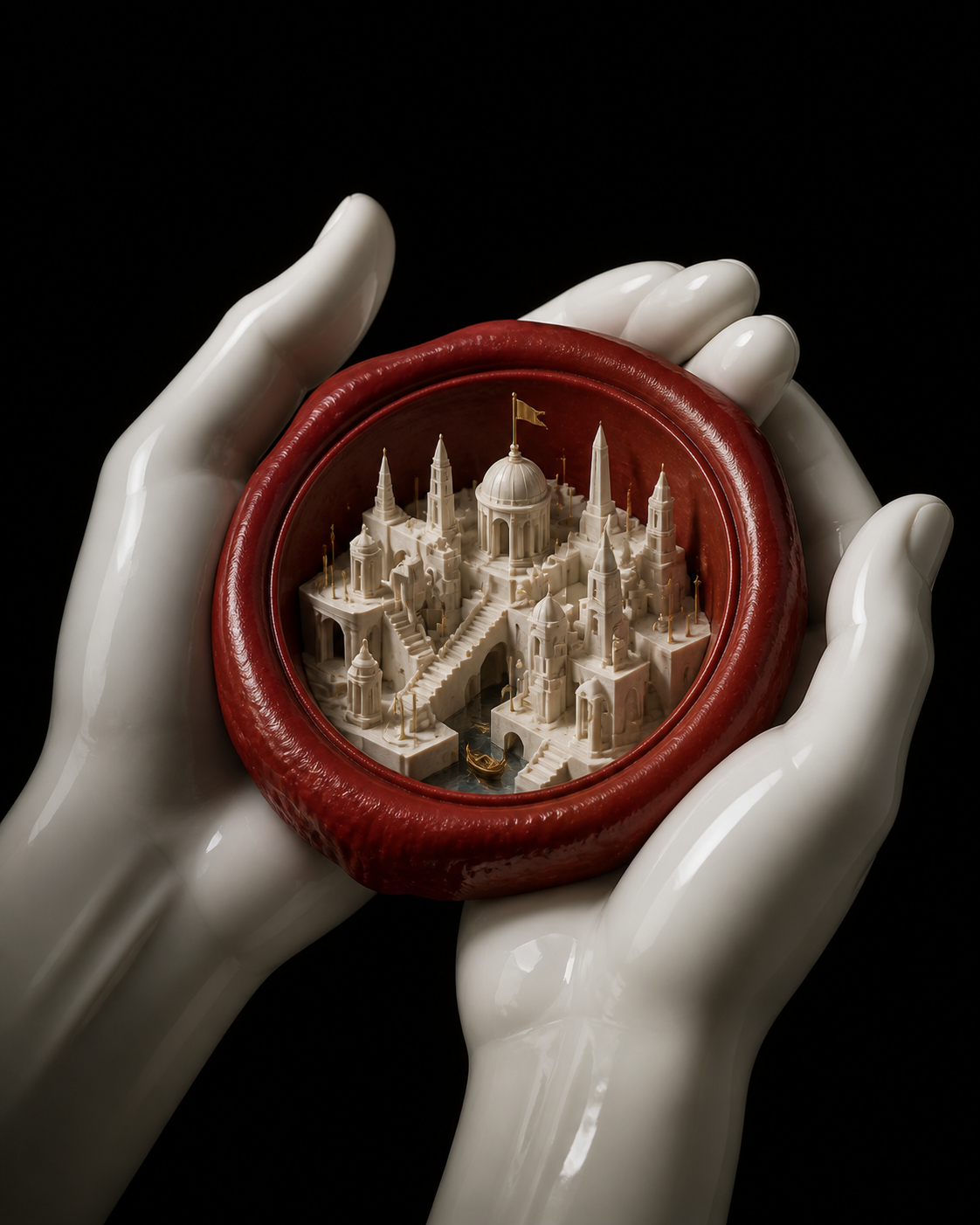
The kingdom occupies an old garden between a brick wall and three overturned flowerpots. Its border can be crossed in eleven adult steps, though no citizen has ever admitted doing so without permission.
At six in the morning, while the neighboring city is still a pale arrangement of windows, the royal surveyor walks the perimeter. She carries a length of red thread and a notebook made from the paper around a teabag. The eastern frontier has shifted during the night. Rain loosened the soil beneath the third boundary stone, and an earthworm, acting without diplomatic credentials, has pushed it half a thumb toward the palace.
This is not a small matter merely because it is a matter of millimetres. Beyond the stone lies the Republic of Rosemary, whose inhabitants measure territory by scent rather than distance. If the displaced marker remains, the kingdom will gain a damp crescent of land and lose the confidence of its only trading partner. The surveyor returns the stone, records the earthworm as a natural force and leaves a crumb of oat at the border. Here, law and apology are often the same gesture performed at different speeds.
By eight, petitions have arrived beneath the terracotta saucer where the council meets. A family from the Moss Quarter requests afternoon shade. The baker complains that sparrows are taking the roof from his shop one straw at a time. Three ants demand a crossing beneath the gravel road, presenting as evidence the bodies of two beetles and a drawing of a tunnel nobody can decipher. The Queen listens from a chair carved out of a walnut shell. Her crown is a brass washer too heavy to wear, so it rests on the table and governs by proximity.
The kingdom has no army. It has a Ministry of Paths, which is more expensive and causes nearly as many arguments. Four routes connect the well, the market, the palace and the compost hill. Every stone is known individually. One is warm before noon, one rocks under the left foot, and one contains a vein of quartz that residents touch before difficult conversations. When the minister proposes replacing them with a smooth strip of tile, the chamber falls silent. Efficiency would save seven minutes a year, but it would also erase the places where people have learned to wait for one another.
At eleven, the bell rings without being touched. The bell is an acorn cap suspended from a bent pin, and wind is recognized as an officer of the court when convenient. A sunflower has turned across the palace window, producing an unexpected eclipse. For nineteen minutes the throne room becomes cool and green. Scholars gather to debate whether the event is astronomy, architecture or an act of floral opposition.
The Queen postpones judgment and moves the meeting outdoors. This is considered wise leadership, although she mainly wants to feel the sun. From the palace step she can see almost the entire country: laundry between two lavender stalks, the blue basin used as a harbor after rain, the hospital under a broken pot, and the western field where six radishes constitute the national reserve. To rule a place this small is to be denied the comfort of abstraction. There are no distant provinces and no invisible neighborhoods. Every decision has a face waiting beside it.
Shortly after lunch, the national crisis begins. A child in the neighboring house opens the back door and releases a round orange cat. The animal crosses three foreign states without noticing their existence, settles in the royal square and closes its eyes. Its body covers the palace, half the market and a recently repaired bridge.
Older histories describe cats as weather: impossible to prosecute and dangerous to insult. The council follows emergency protocol. Bakers suspend production. Citizens carry what they can into the Moss Quarter. The Minister of Paths draws a temporary road over the cat’s tail, then withdraws the plan when the tail expresses an opinion. For forty minutes the kingdom exists mostly beneath fur.
No hero drives the animal away. A patch of sunlight moves, and the cat follows it. When the square reappears, one chimney is broken and the acorn bell has vanished. Nobody has died. The Queen orders the damaged bridge rebuilt wider than before, not because the cat requires it, but because evacuating together revealed how often two strangers could not pass.
By evening, the automatic sprinkler begins clicking beyond the wall. This machine belongs to the large world, where water arrives according to a timer rather than a cloud. The kingdom closes its northern gate and places cups beneath the predictable rain. Children cheer as reservoirs fill. Adults inspect the foundations. Progress and disaster descend in identical silver lines.
At dusk the council reconvenes, now without a bell. The sparrow case is settled by granting the birds the bakery roof after nesting season, on condition that they return loose straw. The ants receive their tunnel, but the gravel road will not be straightened. The Moss Quarter is assigned a movable leaf canopy rather than permanent shade. Each compromise is tiny enough to seem ridiculous from an airplane and large enough to alter someone’s tomorrow.
The Queen removes the brass washer from the table and rolls it into a wooden box. With the crown absent, the palace becomes a saucer again. Ministers become gardeners, witnesses become neighbors, and the royal square becomes a patch of soil carrying the warm outline of a sleeping cat.
The kingdom’s seriousness is comic only to those who confuse size with consequence. Great states protect themselves with maps too large to show a doorstep. This one can see every cracked cup, disputed shadow and tired carrier because it has nowhere else to look. Its citizens do not love the kingdom because it is powerful. They love it because neglect has no place to hide.