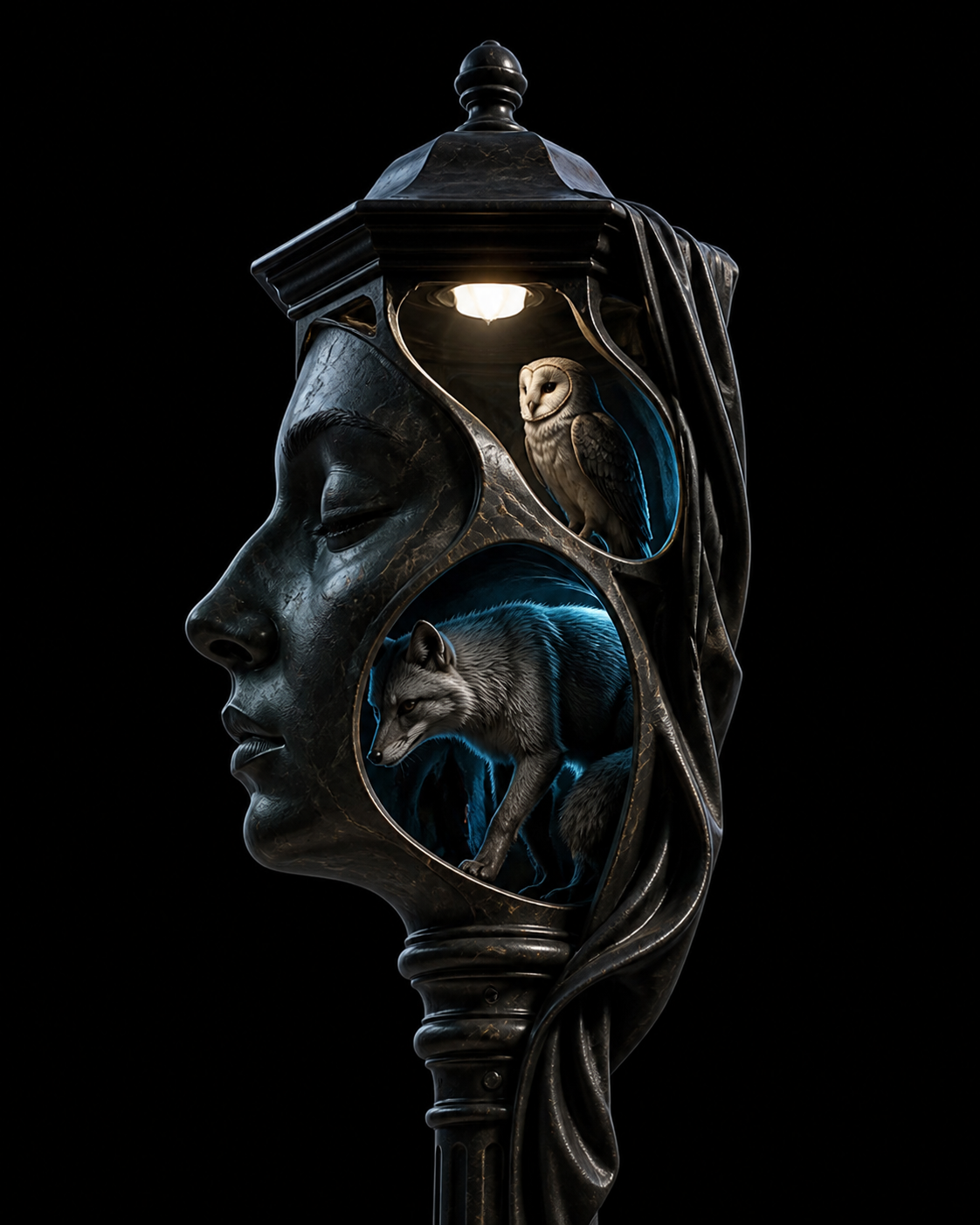
I reach the salt meadow seventeen minutes before sunset with a notebook, a field glass and instructions copied from someone else’s handwriting. The final sentence has been underlined twice: when the deer loses its crown, watch the air above it.
The meadow lies between a pine wood and an estuary. In daylight there is nowhere for an animal larger than a hare to hide. Grass reaches only to my ankles. The mud is pale and uninterrupted except for the stitched tracks of wading birds.
At the western edge, sunlight lowers through the reeds. Green drains out of them from the roots upward. Their tips remain gold while the lower stems turn the colour of old glass.
Something moves where the two colours meet.
At first it resembles an ordinary fox returning to cover. Its body is already grey, but its tail carries a dense red light, as though sunset has become tangled in the fur. The animal does not glow. Grass in front of it remains dark. Only the tail stays red while everything around it loses colour.
The fox crosses the meadow without looking toward me. Where its tail passes, small orange beetles rise from the grass and settle again. A second fox waits beneath the first pines, nearly invisible. The red tail reaches the trees; for a moment both animals can see the path between them. Then the colour goes out.
I mark the time and discover that my pencil line looks brown instead of black. For a moment I wonder whether the fox carried away the red from my pencil as well, leaving behind the colour it no longer needed. This is an unreasonable thought, but the meadow has begun to make reasonable thoughts feel poorly equipped. When I look up, the foxes are gone.
The copied instructions describe a shallow channel beyond the reeds. I find it only because the water reflects a strip of sky brighter than the ground. Halfway across, three pale shapes appear in the reflection beside my own legs. Nothing stands on the bank behind me.
I turn slowly. The bank is empty.
In the water, the shapes lift long ears and begin to run. Their reflected feet disturb no surface. They cross beneath the image of the sky, pass through the reflected sun and vanish under the dark outline of the pines. Only then do three sets of prints appear in the mud ahead, filling one after another as though made by invisible hares. The prints seem less like evidence than an apology from the ground for having shown the animals in the wrong place.
The tracks lead away from the channel.
Beyond the reeds, the meadow forms a low circular hollow. Dried flowers grow around its rim despite the salt. Their stems lean inward. Each flower head is turned toward the same patch of darkness.
The darkness stands up.
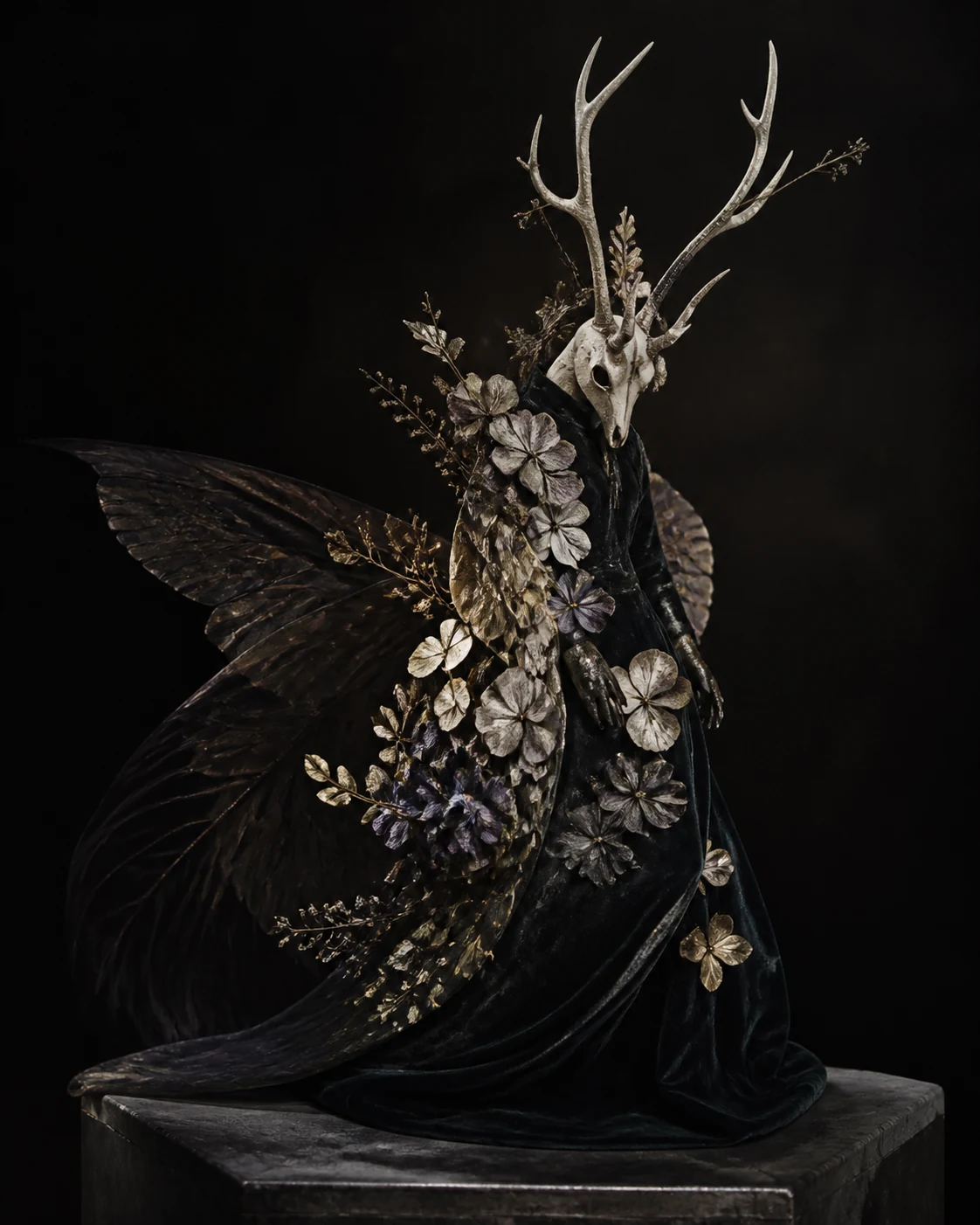
Its legs unfold first, narrow and jointed like those of a deer. A black body rises behind them, draped in layers that could be feathers, leaves or folded wings. Pale flowers cover one shoulder. Above the long skull, antlers branch into the remaining light.
The field glass makes the animal less certain. What looked like velvet along its back separates into hundreds of overlapping wings. What looked like small leaves around the antlers has eyes, legs and soft antennae. Moths cover the creature from its ribs to the highest tine, all resting with their wings closed. Distance had invented one animal; magnification reveals that it was assembled from several hundred.
The deer lowers its head to the dried flowers. Several moths open and close with the movement, changing the shape of its neck. It does not eat. Its breath passes through the flower heads, and a fine dust lifts from them into the colony on its body.
For six minutes nothing else happens.
The sun touches the horizon. A moth leaves the outer point of the left antler. Another rises from the right. They do not scatter. Each circles once above the skull and waits in the air while the next one lifts.
The crown becomes thinner. Gaps appear between its branches. Moths leave the shoulders, then the back, exposing a body much smaller than the silhouette that first stood in the hollow. The animal has been wearing most of its apparent size. I think of all the creatures, including people, whose true outlines would disappoint the rooms they have learned to fill.
I remember the underlined instruction and raise my eyes from the deer.
Above it, the moths are assembling a second creature.
They hang at different heights, each beating its wings just enough to remain still. Together they describe the absent body of a vast bird: hooked beak, hollow breast, wings spanning the hollow. Sky shows through every part of it. The shape exists only because the spaces between moths have become precise.
The bird turns without any moth crossing another’s path. Its beak points toward the estuary.
The deer begins walking beneath it.
I follow at the edge of the hollow. The animal’s true antlers are modest now, two pale forks above the skull. Flowers and a few sleeping moths remain along its flank. It moves carefully, placing each hoof between stems rather than on them.
Near the water, the air has become blue enough to alter distance. The opposite bank seems close, then impossibly far. A palm-sized creature sits on a stone with four thin arms folded against its chest. Its skin is colourless except for a dark pouch beneath the throat.
The last bird stops singing in the pines. At the instant the song ends, the throat pouch turns blue.
The small creature opens it with two hands, removes something as thin as wet paper and folds it once. The folded piece makes no sound, but the meadow becomes quieter. It places the blue fold beneath the stone and waits. I have the absurd impression that evening is not passing at all; it is being taken apart by a patient worker too small to blame.
A distant gate closes. Another blue sheet appears inside the pouch.
When the wind drops between two reeds, it makes a third sheet. When water releases the bank and has not yet returned, it makes another. Beneath the stone, dozens of those narrow intervals lie stacked like translucent leaves. I understand why silence does not fall over the meadow all at once. Someone is folding it into the evening piece by piece.
The deer passes without disturbing it. The moth-bird crosses over the estuary, loosening as it goes. Its breast opens first, then the long beak. The wings divide into separate streams that descend toward the reeds on the far shore. At the water’s edge, the deer turns along the bank and follows the darkening curve back toward the pines.
By the time the sun is gone, the deer has entered the pine wood. Without its colony it is no larger than a young doe. I can still distinguish the pale skull, then only the flowers, then nothing.
The meadow darkens completely. The reflected hares do not return. Under the stone, the blue intervals lose their colour one by one. My notebook contains times, measurements and several drawings that disagree about the shape of the same animal. Perhaps a field note is only a place where certainty goes to acquire handwriting.
At 20:43, as I prepare to close the notebook, a moth settles on the unfinished antler. Its folded wings complete the highest branch.
I wait until it leaves. Then I close the book.